
Billund Heating Plant lowers the heating price and increases flexibility
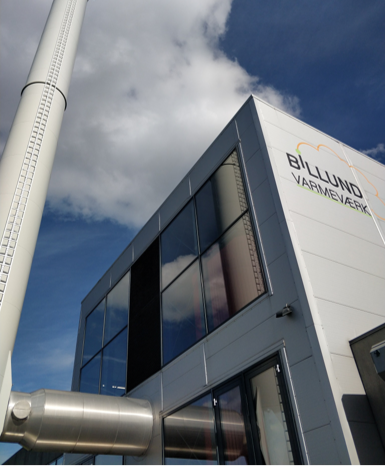
With a large electric boiler, a heat storage tank, and a heat pump, the heating plant takes advantage of being able to use electricity when it is cheapest. The consumption of biomass has been significantly reduced, while the price has been cut by a quarter. Billund Varmeværk is one of the examples highlighted in the CIP Foundation’s work on consumer flexibility.
“Imagine an electric kettle and a thermos. Both just significantly larger.”
Operations manager John Elmertoft from Billund District Heating Plant patiently and clearly explains how they in Billund have managed to take advantage of low electricity prices, which are typically at night during the winter season and during the daytime in the summer, to produce cheap district heating.
Technically, the enlarged electric kettle and thermos are two of the main ingredients in the heating plant’s transition, where they have phased out biomass at full speed over the past year and instead take advantage of the fluctuating electricity prices throughout the day to produce district heating.
“The example from Billund is remarkable. They have succeeded both in turning green electricity into heat in the pipes and in creating space in the budget. At the same time, Billund District Heating Plant supports the energy system of the future by moving electricity consumption to the cheapest hours and stabilizing the electricity grid when needed,” says Charlotte Jepsen, managing partner at CIP Foundation.
New link between electricity and district heating
Billund District Heating Plant supplies 4,200 customers with district heating. Most customers are ordinary households, but there are also a number of housing associations and companies among them, says John Elmertoft.
In many ways, Billund District Heating Plant is the frontrunner in a revitalization of the close partnership that has previously existed between electricity production and district heating.
A quarter of a century ago, many large cities received a significant share of their district heating from surplus heat from power plants. With wind and solar as the main energy sources in electricity production, this surplus heat is no longer available.
As you know, the wind also blows at night, and since electricity consumption is low at night, electricity is cheap. Many electric car owners are already aware of this. By exploiting this, Billund District Heating Plant has breathed new life into the link between electricity production and district heating, now in a completely new way.
Four Olympic-size pools
When electricity is cheap, Billund District Heating Plant starts their electric boiler. The new one has a capacity of 30 megawatts. For comparison, typical household kettles in Danish kitchens are around 1-2 kilowatts. In terms of output, we are therefore talking about something 15,000-30,000 times larger.
Both the “electric kettle” and the “thermos” at Billund District Heating Plant are significantly larger and have a different design than the household versions. The thermal storage tank can hold 10,000 cubic meters – the equivalent of four swimming pools with Olympic dimensions. Converted to energy, the heating plant can store around 700 MWh, corresponding to the consumption in a summer week (when mainly hot water is used) or the consumption on a cold winter day, when houses and apartments need heating, says John Elmertoft.
On 1 July, Billund District Heating Plant reduced the price of heat by 25 percent. Electricity consumption has been nearly free for the heating plant, because they are also a player in the so-called balancing market.
Efficient heat pump
In the electricity grid, production and consumption must be balanced within a fairly small margin. The actors who can contribute to balancing the electricity grid by switching machines and appliances on and off according to the needs of the electricity grid will be paid for this service. It is through participation in this so-called balancing market that the heating plant finances the majority of their electricity purchase.
The electric boiler and the heat storage tank are combined with an air-to-water heat pump, which can also produce hot water. The heat pump has a capacity of 16 megawatts when the air temperature is at freezing point. The advantage of the large heat pump is basically exactly the same as heat pumps for space heating.
While the electric boiler delivers one megawatt of heat for every megawatt of electricity it uses, the heat pump is about three times as efficient, here the amount of energy is multiplied.
“The heat pump is far more efficient, but it is expensive to purchase. Our electric kettle and storage tank cannot compete on efficiency, but they are much cheaper to install,” says John Elmertoft.
Significantly less biomass
With the electric boiler and heat pump, Billund District Heating Plant has managed to reduce the consumption of biomass significantly in just a few years. In 2021, biomass accounted for around 80 percent of the energy used for district heating production. It is expected to be reduced to around 40 percent once the figures for 2025 are finalized.
In 2026, biomass will only account for 20 percent of the energy delivered to heating customers. During 2026, the heat pump will become the key energy source. See figure 1.
Figure 1: Historical and expected production distribution at Billund Varmeværk
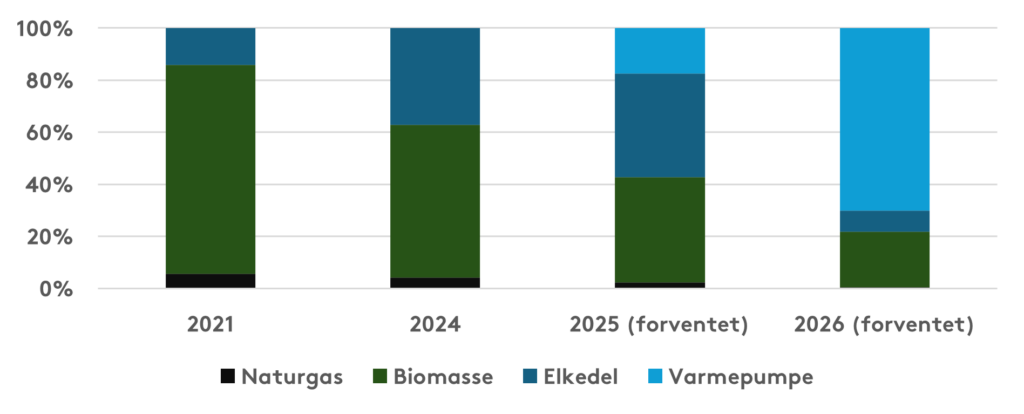
Note: The figure shows the historical and expected distribution of heat production from natural gas, biomass, electric boilers, and
heat pumps at Billund Varmeværk. It illustrates a significant shift from fuel‑based production toward increased electrification,
particularly with heat pumps from 2026.
Biomass consumption in Denmark has doubled since the turn of the millennium, and around one third is imported. According to Statistics Denmark, CO2 emissions from biomass are three times higher than emissions from fossil fuels.
Billund District Heating Plant’s shift toward electricity-based heating delivers a triple benefit, and other heating plants would do well to look in that direction for inspiration, Charlotte Jepsen points out.