When water comes from all directions, we will need more overall flexible solutions
In the future, we will not only experience more floods – we will also see more situations where water hits from multiple sides simultaneously. As weather seasons change, overlaps will occur between different types of floods – from the sea, from rain, from rivers, and from groundwater – which were previously more separated in time and place. This is a problem because floods today are regulated differently depending on the source of the water – with different authorities, rules, and compensation schemes depending on whether it is rainwater, groundwater, seawater, or water from watercourses.
Denmark is getting wetter – and from multiple sources. This is not just a feeling; it is the conclusion of a new analysis made by the Danish Meteorological Institute (DMI) as part of the CIP Foundation’s project on the need for climate adaptation. Climate change will bring more rainfall and alter weather patterns and seasons, meaning that a greater part of the year will be marked by floods from multiple sources – so-called compound events.
These events will become more frequent and are expected to cause some of the most severe future floods. At the same time, pinpointing the exact cause of a flood will become more difficult when multiple sources of water are involved at the same time.
For example, floods might occur in areas where groundwater levels are high and heavy rainfalls occur repeatedly. Or a storm might push seawater onto the coast while it is also raining, and the soil is already saturated with water. In the future, we can expect multiple and more intense floods caused by water coming from several directions at the same time.
Figure 1: The ‘seasons’ of various types of floods will increasing overlap
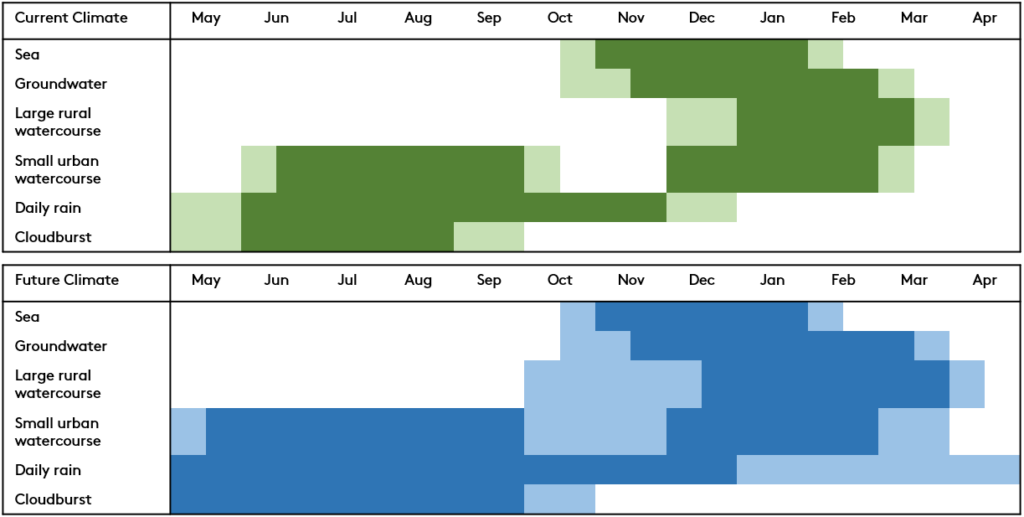
Source: DMI (2025): Floods in Denmark: Causes, connections and climate adaptation strategies
When nature’s forces converge and the water cycle is taken into account, the impact is not just higher water levels but also significantly greater damage. This presents major challenges – not only in respect of who is to pay for the damage but also in respect of determining who is to be responsible for climate adaptation and future prevention.
‘This is a new reality that Denmark is simply not prepared for – neither in terms of our physical climate adaptation, nor legally in terms of our regulatory framework,’ says Charlotte Jepsen, managing partner of the CIP Foundation.
Today, the regulations governing floods differ depending on the source of water. Is it rainwater? Seawater? Groundwater? And does the rain result from a cloudburst or prolonged rainfalls? While the consequences can be serious in all events, the distinction between them determines who is responsible for the climate adaptation – and who is to pick up the bill when damage occurs. But in a future with more compound events and where the cause of a flood will be harder to identify, it will become increasingly difficult to say what source of water triggered the flood – and who is then accountable.
‘As a result, we risk ending up in a situation where the responsibility has not been clarified. Where citizens are left without compensation. Where no one takes the lead on necessary climate proofing, because each stakeholder only acts within their own narrow area of responsibility. And where critical climate adaptation projects end up in legal grey zones,’ says Charlotte Jepsen.
A patchwork of responsibilities
An analysis made by Schjødt Law Firm – also carried out for the CIP Foundation’s climate adaptation project – shows that the legal landscape is characterised by siloes, overlaps and inconsistent funding principles across different types of floods. One type of flood is governed by one set of laws, covered by one kind of damage compensation scheme and follows one financial model, while others are handled based on entirely different rules and logic.
Figure 2: The responsibility for flood compensation and prevention lies primarily with the property owner

The same applies to climate protection measures. In some cases, the cost is covered by the property owner – or by a group of property owners who themselves benefit from the climate protection. In other cases, it is the local wastewater utility that pays, meaning that the cost is shared by everyone who uses water within the supply area. And sometimes, it is the local authority that foots the bill. This makes it a complex and often unclear task for citizens, businesses, and even public authorities to navigate and, as shown by the DMI’s analysis, that task will become even more complicated when the different sources of water meet across regulations.
‘This situation is simply not sustainable. We need to take a more holistic approach – or, at the very least, allow greater flexibility in the potential solutions across different sources of water. This applies both to the regulations themselves and to how climate adaptation is organised. We need frameworks that allow us to think across water sources and make it possible for someone to step up and take responsibility – both as regards prevention and when the damage occurs,’ says Charlotte Jepsen.
A clear answer about the future
It is not just about legal matters. It is about providing security for the citizens and businesses affected and about using society’s collective resources wisely to avoid major damage that could have been prevented and to ensure that individuals are not left to face the consequences of global climate change alone. Individual property owners can contribute, but collective solutions are often needed as well.
‘The climate will not wait – flooding is already happening. The question is whether we want to stay ahead or lag behind. To us, the answer is clear. We need to be several steps ahead,’ says Charlotte Jepsen and continues: ‘The next step for the CIP Foundation is to analyse the stakeholders, their roles and how they can best be involved in the organisation of future climate adaptation efforts and funding models.
In addition, we continue to collaborate with the Technical University of Denmark, DTU, to understand the potential economic damage to society and the social consequences caused by flooding. Here, we include damage from all sources of water – not just damage to buildings but also damage and losses resulting from reduced production and mobility, damage to infrastructure and impacts on shared assets such as culture and nature. Flooding does not just mean flooded basements; it also affects potential societal activity and has an impact on where we can live and operate in the future.’
Read more about the CIP Foundation’s climate adaptation project here.