
Berlin is shaping Europe’s green future
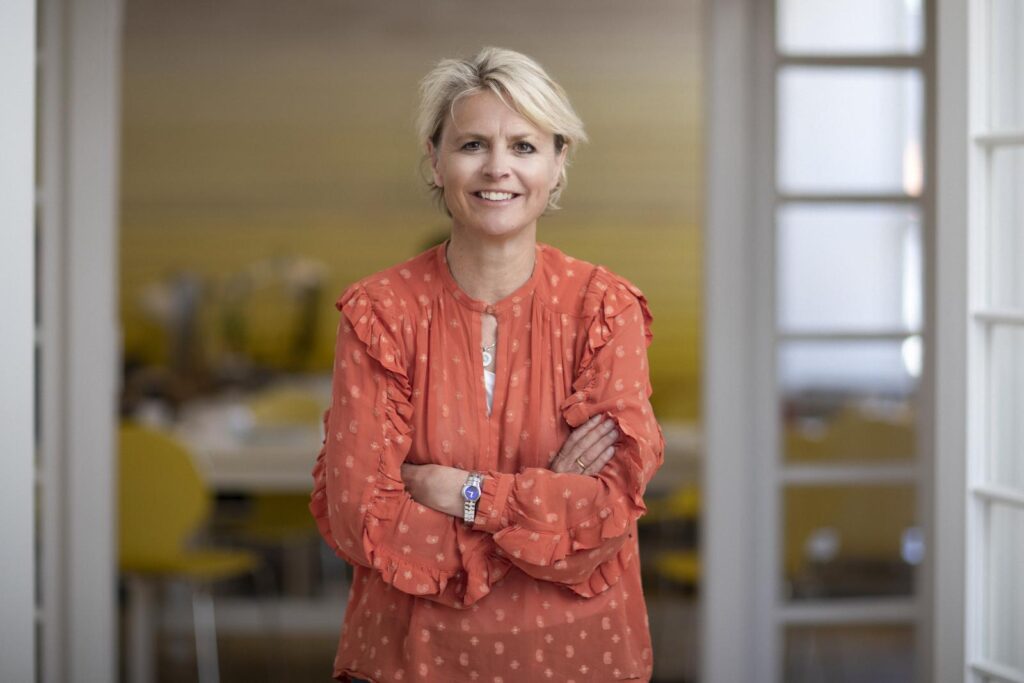
Pressure from Russia and the US may prove to be the game changer that prompts Europe to shift gears and find common solutions. Energy policy is key to security, competitiveness and climate, emphasises Lykke Friis, who describes developments in Germany as crucial.
The success of Germany’s new government will be a key factor for the green transition across Europe. If the newly elected chancellor, Friedrich Merz of the Christian Democratic Union (CDU), succeeds in getting the German economy out of the doldrums, it could also provide a vital nudge towards a stronger – and ultimately greener – Europe.
‘When Germany moves, Europe moves,’ is the point made by Lykke Friis, Director of Think Tank EUROPA. Her CV includes roles such as minister and prorector of the University of Copenhagen, and she has long-standing expertise in EU and German affairs.
Europe is facing new and enormous challenges, but these could also mark the beginning of a step-change for the EU. In her view, developments in Berlin – or perhaps more accurately in rural Germany – will be absolutely decisive.
The war in Ukraine and the election of Donald Trump have set a new agenda for the EU. This shift is clearly evident when comparing the work programmes of Ursula von der Leyen’s first and second European Commissions.
When von der Leyen first assumed office in 2019, climate and the green transition topped the agenda. Today, following her reappointment as President of the European Commission, the green transition has dropped down the agenda, while security and improving Europe’s competitiveness have moved to the top.
‘You no longer win debates by simply getting on your high horse and shouting climate, climate, climate. You have to engage in the debates on security and competitiveness. And lately, security has become even more urgent due to developments in the US,’ says Lykke Friis.
These areas are, however, closely related as energy policy is a central element – whether the focus is on security, competitiveness or climate.
‘Europe’s security is to a great extent about eliminating the dependence on Russian gas, and high energy prices affect the competitiveness of our businesses,’ she points out.
Anti-climate has become a key issue for the far right
However, the road to a German and European energy transition is far from a smooth ride on the Autobahn at 130 km/h. At worst, it is more akin to the traffic jams one encounters near Hamburg on the busiest travel days during the summer.
Along with its opposition to the green transition, the energy and climate policy has become a key issue for the far right – particularly because EU demands for energy efficiency are hitting German households hard.
That is why it is absolutely crucial for the new German government to get off to a strong start with its economic policy. Otherwise, both the CDU and the Social Democratic Party (SPD) risk being squeezed by the EU- and climate-sceptic Alternative für Deutschland (AfD) on the far right.
‘Anti-woke and anti-climate standpoints have climbed to the top of the right-wing agenda. If you look at the AfD, this is something new. In the past, their main issues were immigration and opposition to the euro,’ says Lykke Friis.
Many Danes have failed to realise that the impact of rising energy prices in the wake of the war in Ukraine was much more severe in Germany, she points out.
‘In Denmark, we did not face anything like the problems the Germans did. People were told to go back to using flannels, and they were hardly allowed to turn on the hot water. At the same time, lights were switched off on landmarks like the Brandenburger Tor,’ says Lykke Friis.
Industrial policy – an invasive species
The many challenges notwithstanding, there is another side to the coin. In many ways, Europe’s response to external pressure is to close ranks. The current situation could be the springboard for a quantum leap in EU cooperation not seen since the 1980s.
Observers have repeatedly pointed out that China has established a global leadership position in the electric car market through extensive state subsidies. Similarly, the US Inflation Reduction Act operates along the same lines, offering significant tax incentives for investment in green energy. However, rather than debating state subsidies, Lykke Friis would prefer to shift the focus towards a strengthening of the EU’s internal market.
‘Industrial policy has become a sort of invasive species. Whatever the topic of debate, someone inevitably cites the Draghi report as a reason why we need a more aggressive industrial policy,’ she says.
Lykke Friis argues that it is just as important to consider the less-discussed report on the EU’s internal market presented by former Italian Prime Minister Enrico Letta in the spring of 2024.
‘I sincerely hope we do not end up focusing solely on industrial policy and state subsidies. The Letta report is about strengthening the internal market and extending it to energy, capital, services and several other areas. If we succeed in that, it will lead to strong economic growth in Europe. We have not dared to truly talk about the internal market since the 1980s, and there is enormous potential for the EU here,’ says Lykke Friis.
Energy dependence puts a damper on the political drive
Across the issues of economy, security and climate, Europe faces a paradox: The need for common solutions has never been greater. Meanwhile, fuelled by the opposition to such common solutions, the far right is now stronger than ever.
Nonetheless, Lykke Friis sees reasons for optimism. She views Germany’s decision to lift its so-called debt brake along with the common European decision to strengthen the armed forces by EUR 800 billion as signs that Europe is closing ranks.
‘We have also seen a willingness to seek consensus, driven by the need for Europe to respond to Russia, the US and China. Major common solutions are precisely what is needed to deflate the far right. That is why it is so crucial that mainstream Germany delivers on both the green transition and economic growth,’ she says.
The lesson learned from the war in Ukraine is that Europe’s dependence on energy imports has political consequences.
‘Overall, the amount the EU has spent on fossil fuels from Russia exceeds the support it has provided to Ukraine. The case for independence is now also highlighted by the fact that a good deal of LNG (liquefied natural gas) is being imported from the US,’ says Lykke Friis.
Expansion of energy networks a key task
Despite her deep knowledge and enthusiasm regarding Germany, Lykke Friis resorts to an Anglo-Saxon term to explain one of the most crucial manoeuvres in European politics at the moment. Right now, discussions in government offices are focused on ‘de-risking’, that is, minimising or entirely eliminating all forms of risks, ranging from security risks to economic risks.
Precisely because both the EU and individual countries are learning from past mistakes, we should not expect a close alliance with China on green technologies. While it is true that China, together with Europe, has led the way in green innovation, Europe must not replace its dependence on Russian gas and US security guarantees with dependence on technology or essential raw materials from China.
Instead, Europe must stand on its own feet. One of the major tasks ahead for the new European Commission – and particularly the Danish Commissioner for Energy and Housing Dan Jørgensen – is to build and strengthen European energy networks. This includes both a reinforced European electricity network that can secure electrification and the hydrogen pipelines that can secure independence from fossil fuels.
On an EU level, this will be one of the toughest litmus tests for whether the will to find common solutions can in fact deliver results, stresses Lykke Friis.
‘There are widely varying interests, but it will be essential to resolve this if Europe is to become greener and safer, and if European businesses and consumers are to be guaranteed affordable energy,’ says Lykke Friis.